Brief history

Brief History of Patrick and Bridget McIntyre

Patrick McIntyre (c1831-1901) married Bridget Stevens (c1829-1908) on March 3, 1851 in St. Attracta’s Roman Catholic Church, Toulestrane, County Sligo, Ireland. They had eleven known children. The first five were born in Ireland: Edward (1852-1931); Bartholomew (1854-1924); Mary (1856-1934); Dominick (c1860-1932); and Catherine (1861-1914). Patrick, his wife and five children, left Ireland in 1863 sailing on the SS Orient into New York harbor and finally settling in San Francisco, California where the last six children were born: John Dunn (1864-a1908); Elizabeth (1867-1869); William (1869-1879); James (1871-1874); Thomas (c1874-a1931); and Ellen (1879-1963). Patrick and Bridget homesteaded in Oregon in the 1880s. Patrick died in 1901 and Bridget died in 1908. They are both buried in Mt. Calvary Cemetery, Portland, Oregon.

Patrick's parents, Edward (c1805/6-1881) and Ann McIntyre (c1803/07-1889), both born in Ireland, also came to the US settling in the San Francisco area. From the records, it appears Edward and Ann came a few years before Patrick.


Tuesday, March 17, 2015

Manuel McIntyre, Grandson of Patrick and Bridget

The grandson of Patrick McIntyre (c1831-1901) and Bridget Stevens McIntyre (c1829-1908) and son of Bartholomew McIntire (1854-1924) and Concepcion Ramos (d1924) had a most interesting, and sometimes heavy-hearted, life.

Manuel McIntyre was born in San Francisco on August 15, 1890 on the feast of the Assumption. He joined the U.S. Army during World War I and by the end of his military career, he held the rank of Corporal.

1918

During the war, family history tells that he was exposed to mustard gas which caused nerve damage in both his legs and made him crippled but this did not stop him from loving life. He was very energetic and used two canes to get around.

In the very early 1920s, he married Anna M. Bergman who was born on January 16, 1890 in Sweden. The couple had two children born in San Francisco: a son Robert McIntyre born in 1922 and a daughter, Rose Catherine born in 1925. 

Manuel was a machinist in a machine shop, an auto mechanic and later a mechanic in the steel industry. He earned enough money to own his own home in 1930 in San Francisco on Brazil Avenue.

Joanie Hamilton Zandona recalls how her mother, Elizabeth Artiga Hamilton Snipper (1923-2013), told her many stories about how much fun had when Uncle Manuel would come to visit at her mother Mercedes McIntyre Artiga's (1896-1978) home. Manuel taught Mercedes how to drive in a 1926 Packard.  Joanie's mother told her how they laughed so hard they almost went off the road.  

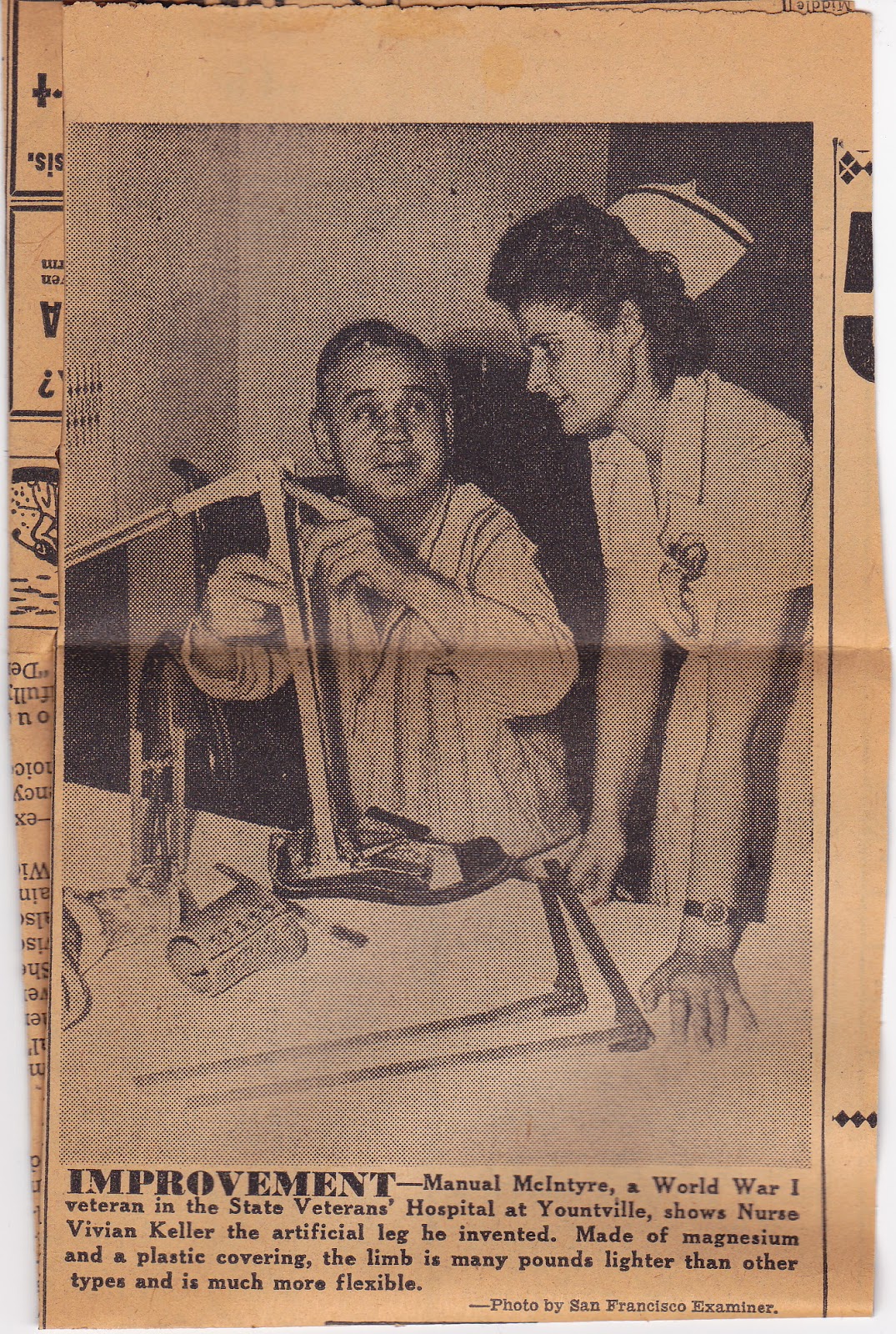
By the mid-1930s, due to his infirmity and a stroke, Manuel was living at the Veteran's Home in Yountville, California. While at the Veteran's Hospital in 1949, he invented a lightweight inexpensive artificial leg. Since his Dad, Bartolo/Bartholomew, had an artificial leg, is it possible this could have been the inspiration for the invention?


Unknown newspaper, 1949


Manual died on July 19, 1950 in the Yountville Veteran's Home. He is buried in Golden Gate National Cemetery, San Bruno, California.


Golden Gate National Cemetery, San Bruno, California

In a letter translated by Patricia Morales Tijerino (grand niece of Manuel) from Maria McIntyre Ruiz (1883-1952) to her sister Elena McIntyre Morales (1886-1974), Maria told about their brother, Manuel's funeral. "On Friday they will go back to Yountville to do the military honors at one in the afternoon. Manuel liked the tribute ceremony to veterans very much."

Photo sources: Sal Bigone and Joanie Zandona

Friday, February 6, 2015

Patrick and Michael McIntyre, Uncle and Nephew?

For several years, the descendants of Patrick McIntyre (c1831-1902) and I, a descendant of Michael McIntyre (c1805-1891), felt we were related, but couldn't prove it. Since that time, we have learned that Patrick McIntyre's father is Edward McIntyre (c1806-1881) AND several of Patrick and Michael's descendants have taken DNA tests.  First the article I wrote for my genealogy society last year.

Not Proven on Paper –
At Least Not Yet – But Proven
By Elaine McIntyre Beaudoin

When I was a teenager, I remember hearing stories from my Dad about the grand summer of 1923 when he visited his grandparents’ farm in the little townland of Lislea, County Sligo, Ireland.  He told of how he would tease the bull in the pasture and then run for the fence when it started to charge at him; of the donkey he relished riding and how he shadowed him wherever my Dad walked; and, of how annoyed his older sister, Mary, was by lack of modern conveniences and the absence of in-house running water. He thought it was all great fun as any six year old child might. Later I learned the townland of Lislea was barely more than half a square mile in size and had less than 20 families living there in the mid-1800s and early 1900s.

In 1982 I vacationed in Ireland and decided it would be interesting to see if I could find this little patch of land known to me as the “McIntyre Family Farm.” I had no interest in genealogy at the time; I just thought it would be an exciting adventure to find the land about which I had heard my Dad reminisce. Stopping at the local Irish post office, I asked the postmaster if he could direct me to the McIntyre farm. Receiving a blank stare, I searched my memory for other family names and remembered a McIntyre daughter had married a Haran. Once I offered this name, I was swiftly directed to the homestead. We were warmly welcomed by my widowed third cousin who was living in the cottage, as well as her sister who was visiting, after I worked through my relationship with them, that is. It was about 10:00 a.m. and they offered me tea and my husband “a wee glass of whiskey” – so Irish.

Bridie Haran Heffernan, Elaine McIntyre Beaudoin, Tessie Haran Cafferty in front of the McIntyre Farm House, Lislea, County Sligo, Ireland, 1982
Fast forward more than 20 years and I have now become an avid genealogist. While researching at the Salt Lake City Family History Library in 2003 I checked my email and found a rootsweb listserv message (the social media of the early part of this century!) entitled “[Sligo] McIntyre Family of Lislea, Kilmacteigue, Sligo, Ireland.”  It listed a Patrick and Bridget (Stevens) McIntyre along with their 10 children all of whom I had never heard of but felt must somehow be related because they were from the same tiny Lislea townland and bore the same surname.

The author of the web post and I communicated on and off for several years about her Patrick McIntyres. We learned members of each of our families had been sponsors and witnesses for the other’s baptisms and weddings. I dutifully researched this other McIntyre family, learning more about them than my own. Since Patrick McIntyre and his family had come to the US in 1863, settling in San Francisco, and my grandfather had not come to the U.S. and Chicago until 1904, I had much more luck finding records and documents on Patrick and his descendants than on my own ancestors.

I dutifully recorded the information I discovered and eventually created a website including all of my genealogy work. The website contained Patrick and his family as well as all of his known descendants because I “just knew” we must be related. Then in 2012 I was contacted by a 3rd great-grandson of Patrick McIntyre, Sal Bigone. He told me he had photos of many of the individuals I had recorded on my website and informed me about many more descendants of Patrick. Together we discovered additional McIntyre offspring in Canada, El Salvador, Nicaragua, Great Britain and Germany as well as Ireland and the US. We became Internet friends and later that year, when I was in the San Francisco area for a wedding, we met and spent the day together with his Mom.

Then in late 2013 I learned one of these Patrick McIntyre “cousins” was going to be traveling between Canada and El Salvador stopping in San Francisco. One thing led to another and suddenly a first McIntyre Family reunion was being planned. With the exception of me, all the other attendees, 13 in total, descended from Patrick and I had the detailed paper trail to prove it.


McIntyre/McIntire Family Reunion, Hayward, California home of Joanie Zandona, January 2014.
By now, I was well invested in these two McIntyre families and had recently begun DNA testing. Unfortunately, among these new “cousins,” there were no males with the McIntyre surname to compare against my paternal uncle’s Y-DNA test results. Since my autosomal DNA was already tested through FamilyTreeDNA, I thought, why not ask the oldest member of this group, Sal’s Mom, to also take an autosomal test.  We guessed we were third or fourth cousins, perhaps once removed. Close enough, we felt, to find some shared chromosomes. The results from the DNA test were returned in June and, alas, our chromosomes did not show a match.  When I received the results, I was extremely disappointed. I really thought we shared the same blood, but my confidence was now waning.  However, I also knew there was about a 50% chance that even if the results didn’t show a relationship, due to the distance of our common ancestor, we still could be related. In the meantime, Sal had decided to have his Mom’s brother tested. And, in late July, the results arrived showing we shared a chromosome segment large enough to suggest our relationship as 4th or 5th cousins.  Indeed, we WERE all cousins!

Matching traditional paper research with DNA testing can be very powerful. We were able to “prove” a family relationship that we may never be skilled enough to demonstrate with documents. Also, posting ancestral information on the Internet, where others can find it, is key to making connections with unknown kinsfolk. Now I understand why they call genealogical websites “cousin bait!”

Having proof we are related will spur us on to continue the paper trail in Ireland.  Knowing the approximate time frame of our common ancestor gives us a focus for the next steps in our research. However, for now, I am just thrilled we have proof we ARE all cousins. Since we have more work to do with Irish records, perhaps our second McIntyre Family Reunion should be held near the sliver of land in Lislea I visited 32 years ago. I will have to suggest this to MY cousins!  But, for the record, I will not propose we include bull pestering, donkey equestrian activities or staying in a facility without modern amenities.

*********************************************************************************************************************************

The DNA results for three descendants of Patrick McIntyre and one descendant of Michael McIntyre show the following in the Family Tree DNA chromosome browser.


We are most likely fourth cousins, once or twice removed if Edward and Patrick are brothers. Given the tiny pieces of DNA we share, these relationships sound just about right

The little bits of black, orange, blue and green colors above are proof that DNA from our ancestors born in the very early 19th century are inside of us in the 21st century.

Now, we just need to find the names of the parents of Edward and Michael McIntyre and, hopefully, we will have proven the relationship on paper too!

Tuesday, February 3, 2015

Our Lady of Guadalupe Catholic Church, San Francisco

Bartholomew (Bartolo) McIntire (1854-1924) married Concepción Ramos (bc1863-1913) on the 7th of July, 1887 at Our Lady of Guadalupe Catholic Church in San Francisco, California. They were married by Fr. Antonio Santandreu. Bartholomew is the second oldest son of Patrick and Bridget (Stevens) McIntyre. See the earlier post regarding the marriage and church.

In 2015, Patricia Morales Tijerino, the great granddaughter of Bartholomew McIntire, and Sal Bigone, the great, great grandson of Mary McIntyre Leonard (Bartholomew's sister), visited the new Our Lady of Guadalupe Church and filmed this video.


Our Lady of Guadalupe Church, Photo by Sal Bigone, 2015


Sources: Video provided by Patricia Morales Tijerino.

Saturday, August 30, 2014

Lislea, County Sligo, in 1825

The Tithe Applotment Books record the results of a unique land survey taken to determine the amount of tax payable by landholders to the Church of Ireland. This data set represents a virtual census for pre-Famine Ireland. 

The image below is from a microfilm of the original hand written book viewed at the Montreal Public Library in 1998. The front page from the section for Kilmacteige Parish is dated November 1, 1825. Note there are three McIntyres on the list for Leslea (Lislea). 
  • Patrick McEntire occupied 14 Irish acres and the land was taxed at 14 shillings
  • James McIntire occupied 1 Irish acre, 2 perches and the land was taxed at 1 shilling, 6 pence
  • John McEntire occupied 11 Irish acres, 3 rods and the land was taxed at 11 shillings
The note to the right of all the land in Lislea reads:

"Eleven Pounds seven shillings and nine pence the sum applotted on two hundred and eight acres and three perches in the Townland of Lislea as annexed."

From this document, it appears there were 26 heads of household/land occupiers living in Lislea in 1825. They are listed on lines 302 - 327 below. If you double click on the image it will enlarge.

Edward McIntyre (c1806-1881), father of Patrick (1831-1901), would have been approximately 19 years old in 1825 and not very likely to be the occupier of a parcel of land. Could one of these individuals, Patrick, James or John, be the father of Edward?  


Irish Mile vs Statute Mile
  1. An Irish acre is a unit of area historically used in Ireland, Yorkshire, and regions bordering the Solway Firth. One Irish acre is equal to about .66 hectares (1.6 acres) (196⁄121) acre, 6600 square meters, or 70,560 square feet. Source: Wikipedia, accessed August 30, 2014.
  2. Table of Constants
    1 Statute Mile = 1760 Yards
    1 Irish Mile = 2240 Yards
    11 Irish Miles = 14 Statute Miles
    1 Statute Acre = 4840 SQ. Yards
    1 Irish Acre = 7840 SQ. Yards
    121 Irish Acres = 196 Statute Acres
Source: Ordinance Survey Ireland, http://www.osi.ie/Education/Secondary-Schools/Teacher-Resources/Conversions-(1).aspx, accessed August 30, 2014


British Pound, Shilling vs American Dollar

In 1825, one British pound was equivalent to 93 British pounds in 2013. Source: http://safalra.com/other/historical-uk-inflation-price-conversion/

There were 20 shillings to a pound, so one 1825 shilling would be worth 93/20 or $4.65 today. As an example in the above, Patrick paid 14 shillings or the equivalent of 14x4.65 = $65.10 in taxes for his 14 Irish acres.


Information on the Tithe Applotment

Background
The money so raised was for the upkeep of the Church of Ireland, the established church until 1869. The word tithe comes from the Latin for a tenth part, and refers to the custom of paying a tenth of one's earnings to the church. Originally this offering was in kind, but as money increasingly became the determinant of social and economic dealings, the tithe came to be paid similarly. Following the Composition Act of 1823, which decreed that tithes be paid in money, a valuation survey was carried out of each civil parish in Ireland to determine how much each landholder should pay. Over the next fifteen years this survey listed all landholders in a parish.
Assessing the Tithe
The survey was conducted by those who stood to gain from tithes, namely personnel of the Church of Ireland, usually members of the select vestry or apploters appointed by them 'to regulate and sub-divide'. The applotment enumerated each landholder in a parish, with details such as name of townland, size of holding, land-quality and types of crops. The amount of tithe payable by each landholder was based on all of these factors and calculated by a formula using the average price of wheat and oats from 1816-23. Most parishes had at least one tithe survey during from 1820-38 while some had two. Some parts of the country were exempt from paying tithe, among them glebe lands (land occupied by established clergymen), granges (land which in pre-Reformation times had belonged to a monastery) and all towns.
Opposition to Tithes
All this was eminently logical and scientific except for one rather serious snag; the tithe was to be paid by everyone, not just members of the Church of Ireland. Therefore, it was deeply unpopular with Catholics and Presbyterians who had their own clergy and who resented having to support a rival denomination whose members enjoyed more social and economic privileges than they. Furthermore, Catholics and Presbyterians between them outnumbered the established church, the latter being the preserve of those with social and political power. Not surprisingly there were instances of violent resistance, and numerous outbreaks of agrarian unrest in the 1830s were dubbed the 'tithe war'.
The End of Tithes
Tithes were payable directly to the Protestant minister, but collection was often difficult as people held out against the indignity and the financial burden. It should be remembered that all landholders had to pay tithe, and the majority of these were impoverished tenants already faced with heavy rents payable to their landlord. From 1838 on, the tithe was amalgamated with the land-rent and collected by landlords, who then passed on the church's share. This had the double effect of removing the trouble of collection from ministers and also of making payment more likely, given that non-payment of dues to the landlord could lead to eviction. Resentment against tithes festered as one of the ills associated with Ireland's ramshackle landlord system until the disestablishment of the Church of Ireland in 1869. Thereafter this denomination had to raise its own finance in the manner of other churches.
Exceptions
In total the Tithe Applotment Books comprise some 2,000 hand-written volumes of varying degrees of legibility. Even allowing for the exemption of town-dwellers and landless labourers from the survey, it still constitutes the nearest to a census of pre-Famine Ireland that we have - especially in light of the absence of formal census data from this period. As mentioned above, however, it is not comprehensive and some parts of the country were not surveyed. It should not be assumed that these 'exceptions' from the tithe survey were due to parishes being overlooked since there are usually explanations as to why they were tithe-free. In some cases there are no tithe books because a certain parish did not exist, or was part of another parish, at the time of the survey. There were also some parishes outside parochial jurisdiction, such as the above-mentioned granges, while glebe lands and all towns were also exempt. Details of exceptions are provided below. (1)

Source: The Tithe Applotment Books of Ireland, 1823-1838: www.genealogy.com accessed August 29, 2014.

Note: I have copied this blog to the www.mcintyreginty.blogspot.com site as either Patrick, James or John should be Michael McIntyre's father as well.

Friday, August 29, 2014

Bridge at La Toma, El Salvador

Bartolo McIntire, Engineer

Bartolo/Bartholomew McIntire (1854-1924), son of Patrick and Bridget, was an engineer and builder of bridges in Central America, in particular, El Salvador. The bridge at La Toma pictured below was designed by Bartolo and built in the early part of the 20th century.

La Toma was a recreational place with a pool about 30 kilometers away from San Salvador heading north near the properties of the Melendez Family. In that area, there were (and still are) sugar cane plantations. The Melendez Family was a very powerful family in El Salvador with two of its members holding the office of President.  

Bartolo and the Melendez family worked closely together on many projects in El Salvador.

Bridge at La Toma, El Salvador


Reverse side of photo

The text reads:

Puente "La Toma" sobre el río Acelhuate, jurisdicción de Guazapa, San Salvador, construido bajo la dirección del señor Ingeniero Don Bartolo McIntire
Concepción R. de McIntire,  S S junio 14/910

Bridge "La Toma" over the Acelhuate River, jurisdiction of Guazapa, San Salvador, built under the direction of the Engineer Bartolo McIntire 
Concepción R. de McIntire, San Salvador, June 14, 1910

Concepción was the wife of Bartolo.

Sal Bigone, while going through the family "trunk," came across the photo above and graciously shares it with the family. Thank you Sal.  And, a big thank you to Juan José Morales and Patricia Morales Tijerino for transcribing and translating the note on the back of the photo as well as providing some additional commentary.

Thursday, August 21, 2014

Death notices for Edward and Ann McIntyre, Parents of Patrick McIntyre

We have pretty good proof that Edward and Ann McIntyre are the parents of Patrick McIntyre. See the post on this blog considering the reasons why at: Possible Parents of Patrick McIntyre? It seems so.

Death notice for Edward McIntyre


MCINTYRE - In this city, March 2, Edward McIntyre, a native of Ireland, aged 75 years.
Source: The San Francisco Examiner, March 4, 1881, page 4.

Death notice for Ann McIntire


MCINTIRE - In this city, February 28, Ann, beloved mother of Patrick McIntire, a native of Ireland, aged 86 years.
Source: The San Francisco Examiner, March 1, 1889, page 5.

Possible Parents of Patrick McIntyre? It seems so.

When Patrick and Bridget's daughter Elizabeth died at 2 years of age in 1869, Patrick bought several graves in Calvary Cemetery, San Francisco, California.  Around 1940, Calvary Cemetery, as were other cemeteries in the city of San Francisco, was emptied to make way for the growth of the city.  Many of the graves in Calvary Cemetery were moved to Holy Cross Cemetery in Colma, a suburb of San Francisco.

The remains in the graves that Patrick McIntyre purchased were also removed to Holy Cross in 1940.  In some of the graves little more than dust was found.  The nature of the find when the Calvary graves were dug up, was recorded on "Removal Record" cards.  Many of these cards have been scanned and are viewable on the San Francisco Genealogy website along with images of the original burial register book.

In searching the site, in addition to locating the Removal Records for Elizabeth (2) and William (10) and possibly son James (3), two adults were recorded.


Could Ed and Annie be the parents of Patrick McIntyre? YES!  The argument for:
  • They are obviously related somehow to Patrick, given they share the same last name and are buried in the same plot as Patrick's children. 
  • Given the ages listed, Ed would have been born circa 1806-1807 and Annie would have been born circa 1807-1808, certainly old enough to have a son born in 1831, the believed birth year of Patrick. 
  • From San Francisco City Directories (1861-1883) Edward and Patrick both lived at the corner of Larkin and Francisco between 1863 and 1879.
  • The Irish naming pattern is to name the first son after the Father's Father.  Patrick's oldest son is named Edward. 
  • Ann is listed as the mother of Patrick McIntyre in her death notice dated March 1, 1889 in the San Francisco Examiner.
  • Edward is listed as "married" in the Register of Interments, Calvary Cemetery, San Francisco, California, March 2, 1881.
  • Ann is listed as "widow" in the Register of Interments, Calvary Cemetery, San Francisco, California, February 28, 1889.
Although none of the individual points above is proof that Edward and Annie are the parents of Patrick, the collective information, so far, supports the idea.

Information updated August 21, 2014.